There is no universal carry-on standard. IATA publishes a recommended cabin bag size of 55 × 35 × 20 cm, but most airlines ignore it in favour of their own specifications. The practical result is that a case that fits in the overhead bin on Lufthansa may exceed the stated limit on Ryanair, and a bag compliant on an EasyJet FLEXI fare may not be permitted under an EasyJet Standard fare. The fare class distinction matters as much as the carrier.
The rules below are verified as of January 2026. Airline policies change — sometimes seasonally, sometimes with fare restructures — so checking directly with the carrier before departure is always worth doing, particularly on low-cost routes where enforcement is stricter and fees for oversized bags run high.
Carry-on size rules: major European airlines at a glance
The entries below cover cabin bag (main overhead item) dimensions, weight limits where stated, and personal item allowances. Dimensions are listed as height × width × depth in centimetres.
Full-service carriers
Lufthansa 55 × 40 × 23 cm · 8 kg · Personal item: 40 × 30 × 10 cm · Business Class allows up to two cabin items
Swiss (SWISS) 55 × 40 × 23 cm · 8 kg · Personal item: 40 × 30 × 10 cm · Same group policy as Lufthansa; enforced consistently
Austrian Airlines 55 × 40 × 23 cm · 8 kg · Personal item: 40 × 30 × 10 cm · Luggage policy aligned with Lufthansa Group
Brussels Airlines 55 × 40 × 23 cm · 8 kg · Personal item: 40 × 30 × 10 cm · Lufthansa Group carrier — same allowances apply
Air France 55 × 35 × 25 cm · 12 kg · Personal item: 40 × 30 × 15 cm · Generous weight limit; dimensions slightly narrower than Lufthansa
KLM 55 × 35 × 25 cm · 12 kg · Personal item: 40 × 30 × 15 cm · Air France-KLM policy; identical allowances across both carriers
British Airways 56 × 45 × 25 cm · No stated limit · Personal item: 40 × 30 × 15 cm · One of the larger cabin bag allowances in Europe; weight not enforced at cabin level
Iberia 56 × 45 × 25 cm · No stated limit · Personal item: 35 × 20 × 20 cm · IAG group; same dimensions as British Airways
SAS Scandinavian 55 × 40 × 23 cm · 8 kg · Personal item: 40 × 30 × 15 cm · Economy Light fare restricts to personal item only
Finnair 55 × 40 × 23 cm · 8 kg · Personal item: 40 × 30 × 15 cm · Light fare allows personal item only, no cabin bag
Turkish Airlines 55 × 40 × 23 cm · 8 kg · Personal item: 40 × 30 × 15 cm · Applies across most fare classes in Economy
TAP Air Portugal 55 × 40 × 20 cm · 8 kg · Personal item: 40 × 30 × 15 cm · Discount fares may restrict to personal item only
Low-cost and hybrid carriers
Ryanair 40 × 30 × 20 cm (small bag, free) / 55 × 40 × 20 cm (large bag, Priority required) · No stated weight limit · Personal item: Included in small bag allowance · The most restrictive major carrier. Priority boarding or Plus/Family Plus fare required for overhead bin access with the larger bag. Without Priority, the 40 × 30 × 20 cm bag goes under the seat only.
EasyJet 56 × 45 × 25 cm · No stated limit · Personal item: Up to 45 × 36 × 20 cm · Standard and FLEXI fares include overhead bin access. Essential (cheapest) fares: personal item under seat only. Enforce sizing at the gate on busy routes.
Wizz Air 40 × 30 × 20 cm (free) / 55 × 40 × 23 cm (WIZZPRIORITY or Plus required) · No stated weight limit · Personal item: Included in free allowance · Structure similar to Ryanair. Without WIZZPRIORITY, only the 40 × 30 × 20 cm bag is guaranteed. Overhead bin access requires a fare upgrade or add-on.
Eurowings 55 × 40 × 23 cm · 8 kg · Personal item: No separate personal item stated · BASIC fares may restrict cabin bag. SMART and higher fares include full allowance. Part of Lufthansa Group but operates separate fare rules.
Vueling 55 × 40 × 20 cm · No stated limit · Personal item: 35 × 20 × 20 cm · IAG carrier. Optima fares include overhead cabin bag; Basic fares do not.
Norwegian 55 × 40 × 23 cm · No stated limit · Personal item: 25 × 33 × 20 cm · LowFare tickets: personal item only under seat. LowFare+ and Flex include cabin bag.
Transavia 55 × 35 × 25 cm · No stated limit · Personal item: 40 × 30 × 10 cm · Air France subsidiary. Basic fares restrict to personal item only.
Jet2 56 × 45 × 25 cm · No stated limit · Personal item: No separate personal item · One of the most generous low-cost allowances. No weight enforcement at cabin level on most routes.
Volotea 55 × 40 × 20 cm · No stated limit · Personal item: 40 × 30 × 20 cm · Basic fares may require paying for cabin bag access. Check at booking.
Long-haul and intercontinental carriers (departing Europe)
Emirates 55 × 38 × 20 cm · 7 kg · Personal item: Included in allowance · Strictly enforced; weight limit applied at check-in on some routes
Qatar Airways 50 × 37 × 25 cm · 7 kg · Personal item: Included in allowance · One of the smaller cabin bag dimensions among major long-haul carriers
Singapore Airlines 54 × 38 × 23 cm · 7 kg · Personal item: Included in allowance · First and Business Class have more generous allowances
Delta (from Europe) 56 × 35 × 23 cm · No stated limit · Personal item: 45 × 35 × 20 cm · Overhead bin access included for all fares departing Europe
United (from Europe) 56 × 35 × 22 cm · No stated limit · Personal item: 45 × 35 × 20 cm · Basic Economy may restrict overhead bin use — confirm at booking
American Airlines (from Europe) 56 × 36 × 23 cm · No stated limit · Personal item: 45 × 35 × 20 cm · Basic Economy on transatlantic routes: personal item only
How to measure your luggage correctly
Airline dimension limits include all external protrusions — wheels, handles, feet, and any external pockets. Measuring the shell alone understates the true external size by 2–4 cm on most hard-shell cases. Use a tape measure and include the widest point at each axis: height from the floor to the top of the extended handle retracted flush, width at the widest external point, depth including any curved sections and feet.
Most airlines use a physical sizer at the gate on busy routes. If the case fits in the sizer, it boards. If it does not, the consequences are immediate: gate-checked bags typically incur fees of €30–60 on low-cost carriers, and that is assuming the airline does not simply redirect it to the hold without your consent. The sizer, not the stated dimensions, is the true test.
A useful rule of thumb: if a case is within 2–3 cm of the stated limit in any dimension, treat it as borderline and check whether the airline uses a physical sizer on your route. On Ryanair routes from Stansted, Dublin, or Charleroi, sizers are used consistently. On Lufthansa routes from Frankfurt or Munich, enforcement is lighter but not absent.
The weight limit question
Weight limits for cabin baggage are set by more airlines than most travellers realise, but enforced by fewer. Lufthansa, Swiss, Austrian, and Turkish all state an 8 kg cabin limit. Air France and KLM state 12 kg. Most low-cost carriers state no weight limit for the cabin bag itself — but enforce a per-bag weight limit through the cost structure of their checked baggage pricing.
The carriers that enforce cabin weight limits actively are primarily the full-service group: Lufthansa Group airlines weigh carry-on bags at check-in on some routes, particularly out of Frankfurt and Munich on busy morning business departures. Turkish Airlines enforces at check-in on most routes. Emirates and Qatar enforce the 7 kg limit with notable consistency.
The practical conclusion: on Ryanair, EasyJet, or Wizz Air, cabin bag weight is rarely the constraint. On Lufthansa, Swiss, or Emirates, 8 kg is a real ceiling on some routes. Pack with that in mind if your itinerary switches between carrier types within the same week.
Which Horizn cases fit which airline allowances
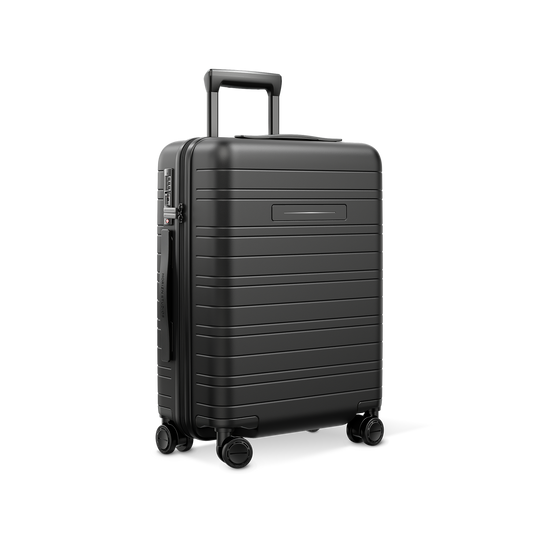
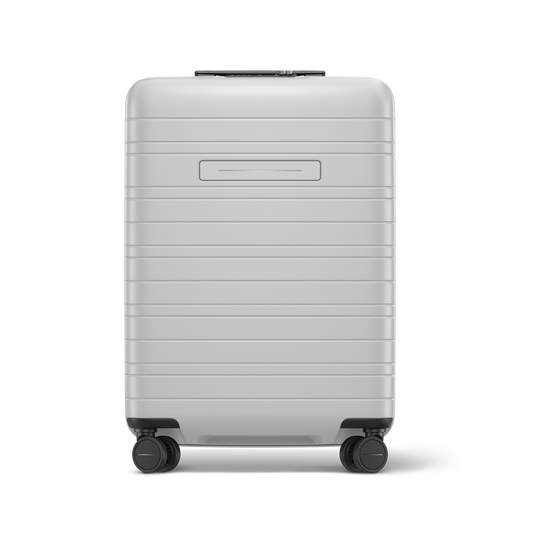
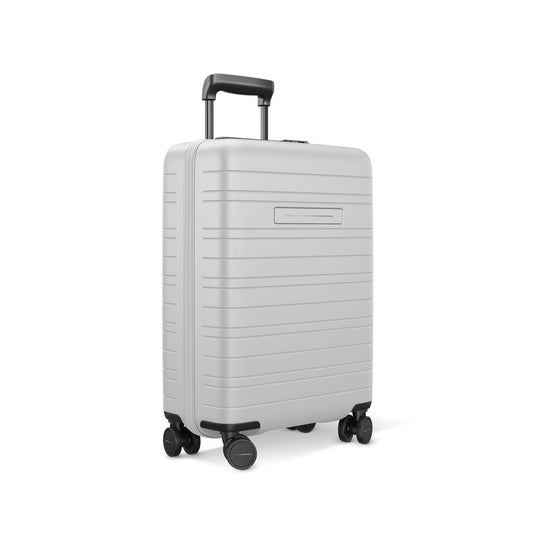
The H5 Essential and H5 Pro (both 55 × 40 × 20 cm, 2.9 kg) sit within the allowances of the large majority of European carriers: Lufthansa Group, Air France-KLM, SAS, Finnair, Turkish, TAP, EasyJet, and most IAG carriers including British Airways and Iberia. The 20 cm depth keeps these cases well within the narrower depth limits that catch some cases by surprise.
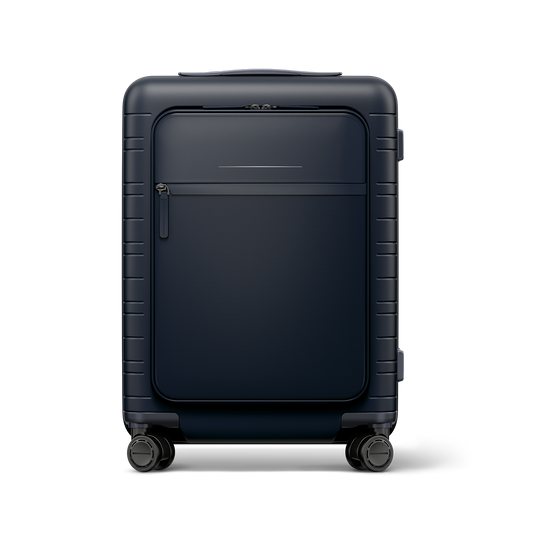
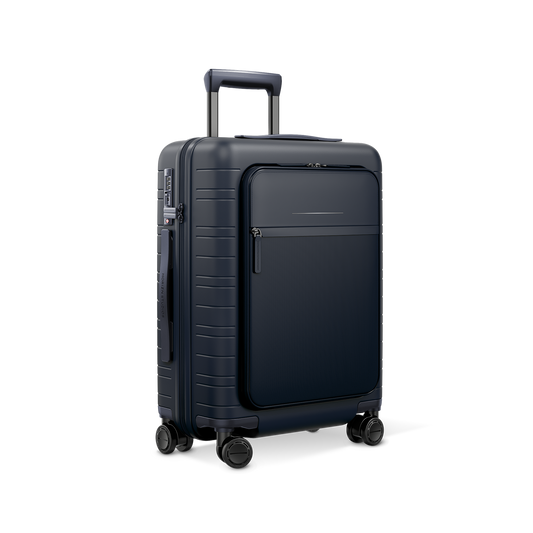
The M5 Pro and M5 Essential (both 55 × 40 × 23 cm, 3.4–3.5 kg) add 3 cm of depth for the front-access laptop pocket. This still fits within Lufthansa (23 cm), Swiss (23 cm), Eurowings (23 cm), EasyJet (25 cm), and British Airways (25 cm). It does not fit the stated Ryanair large bag limit of 55 × 40 × 20 cm, though in practice Ryanair's sizer accepts cases up to 55 × 40 × 20 cm and the M5 has been reported to fit without issue on most routes. Confirm before relying on it.
The H5 Air (55 × 37 × 20 cm, 2.1 kg) is the most conservative option on dimension compliance. At 37 cm wide rather than 40 cm, it provides the most margin on carriers that enforce width strictly, and the 2.1 kg empty weight leaves meaningful capacity on routes with combined weight limits. For travellers on Ryanair or Wizz Air without Priority boarding who need the larger bag allowance, the H5 Air's dimensions are the most reliable fit.
Personal items: the second allowance most travellers underuse
Almost every airline permits a personal item in addition to the cabin bag. This is typically a handbag, laptop bag, backpack, or small daypack that must fit under the seat in front. The size limit varies: 40 × 30 × 15 cm on Lufthansa, 45 × 36 × 20 cm on EasyJet, 40 × 30 × 15 cm on Air France. On Ryanair, the personal item is the free 40 × 30 × 20 cm bag — there is no separate personal item allowance.
Using the personal item allowance effectively doubles your total cabin packing capacity without triggering any additional fees. A laptop bag, the Gion Backpack Pro (31 × 46 × 16 cm, 750 g), or the Gion Briefcase (41 × 29 × 9 cm, 1 kg) each fit comfortably within most European personal item allowances and carry a 16" laptop, documents, and daily essentials. The cabin case then handles clothing and larger items without competing for the same space.
What happens when your bag fails the check
Gate-checked bags are the standard outcome when a cabin case fails a dimension or weight check at boarding. On Ryanair, the gate check fee is currently €50–70 depending on route and timing. On EasyJet, it runs €45–65. On Vueling and Transavia, similar. These fees are applied immediately and cannot be disputed at the gate.
Beyond the fee, gate-checked bags go into the hold as standard checked luggage — which means they may not arrive at the destination on the same flight if the aircraft is full, and may be subject to the same mishandling risk as any checked bag. The SITA 2025 Baggage Report puts that rate at 6.3 bags per 1,000 passengers in 2024. It is a recoverable situation, but a disruptive one on a business trip that begins at the gate.
The simplest way to avoid it: measure your bag externally before leaving home, including wheels and handles. If you are borderline, pack lighter to stay inside the weight limit and consider whether Priority boarding or a fare upgrade is worth the cost against the risk of a gate fee.
Frequently asked questions
What is the standard carry-on size for European airlines in 2026?
There is no single standard. IATA recommends 55 × 35 × 20 cm, but most airlines set their own rules. The most common full-service allowance across Lufthansa Group, SAS, Finnair, and Turkish is 55 × 40 × 23 cm with an 8 kg limit. EasyJet allows 56 × 45 × 25 cm. Ryanair without Priority limits you to 40 × 30 × 20 cm under the seat. Always check your specific fare class.
Does carry-on size vary by fare class on the same airline?
Yes, significantly. Ryanair's basic fare allows only a 40 × 30 × 20 cm bag under the seat; Priority boarding or a Plus fare is required for overhead bin access with the larger 55 × 40 × 20 cm case. EasyJet's Essential fare restricts to personal item under seat only. SAS and Finnair Light fares allow no cabin bag at all. The fare class distinction is as important as the carrier when planning cabin-only travel.
Do airlines enforce carry-on weight limits?
Selectively. Lufthansa, Swiss, Austrian, Turkish, Emirates, and Qatar actively weigh cabin bags on some routes — particularly on busy morning departures from Frankfurt, Munich, Istanbul, and Dubai. Ryanair, EasyJet, Wizz Air, and most other low-cost carriers do not enforce cabin weight, focusing instead on dimension compliance at the gate sizer. If your itinerary mixes carrier types, plan for the stricter standard.
What does Ryanair's carry-on policy actually allow in 2026?
Without Priority boarding: one bag at 40 × 30 × 20 cm, stored under the seat only. With Priority boarding or a Plus/Family Plus fare: one bag at 55 × 40 × 20 cm in the overhead bin, plus one 40 × 30 × 20 cm personal item under the seat. Ryanair is the most restrictive major European carrier and enforces dimensions at gate sizers on most routes. If flying Ryanair without Priority, the H5 Air at 55 × 37 × 20 cm exceeds the free bag limit and requires Priority boarding or a fare upgrade.
Which Horizn cases fit within Ryanair's carry-on allowance?
With Priority boarding or a Plus fare, the H5 Essential, H5 Pro, and H5 Air all fit within the 55 × 40 × 20 cm large bag allowance. The M5 Pro and M5 Essential at 55 × 40 × 23 cm exceed the stated limit by 3 cm in depth — in practice many travellers report the M5 fitting the sizer, but Horizn cannot guarantee this and the safer choice for strict Ryanair compliance is the H5 range. Without Priority, none of the Horizn cabin cases fits the free 40 × 30 × 20 cm allowance.
Do wheels and handles count toward the carry-on size limit?
Yes. Airline dimension limits cover the total external size of the bag including wheels, feet, handles in the retracted position, and any external pockets or protrusions. Measuring the shell alone typically understates the real external size by 2–4 cm. Always measure from the outermost point at each axis.
What is a personal item and how does it differ from a carry-on?
A personal item is a second, smaller bag — typically a handbag, laptop bag, or small backpack — that must fit under the seat in front. Most European airlines allow one in addition to the cabin bag. Size limits vary: 40 × 30 × 15 cm on Lufthansa, 45 × 36 × 20 cm on EasyJet, 40 × 30 × 15 cm on Air France. Ryanair does not allow a separate personal item — the free small bag serves both functions.
What happens if my carry-on bag fails the gate sizer?
The bag is gate-checked and placed in the hold. Fees on Ryanair currently run €50–70; EasyJet charges €45–65; other low-cost carriers are comparable. The bag travels as standard checked luggage and may not arrive at the destination on the same flight in rare cases. On a business trip, that outcome is worth avoiding — measuring externally before departure, including wheels and handles, is the reliable preventive measure.
Can I bring a laptop in my carry-on bag?
Yes. Laptops are permitted in cabin baggage on all commercial flights in Europe and on most international routes. At security in EU airports and at major international hubs, laptops typically need to be removed from the bag and placed in a separate tray. The M5 Pro and M5 Essential front pocket is designed specifically for this — the laptop comes out in one motion without opening the main case.
How often do carry-on size rules change?
More often than most travellers expect. Low-cost carriers in particular revise fare structures — and with them cabin bag allowances — several times a year. Ryanair, EasyJet, and Wizz Air have each restructured their baggage policies multiple times since 2020. This guide is verified as of January 2026 and is updated annually, but checking directly with your carrier before booking is always the safest approach.